Dear friend,
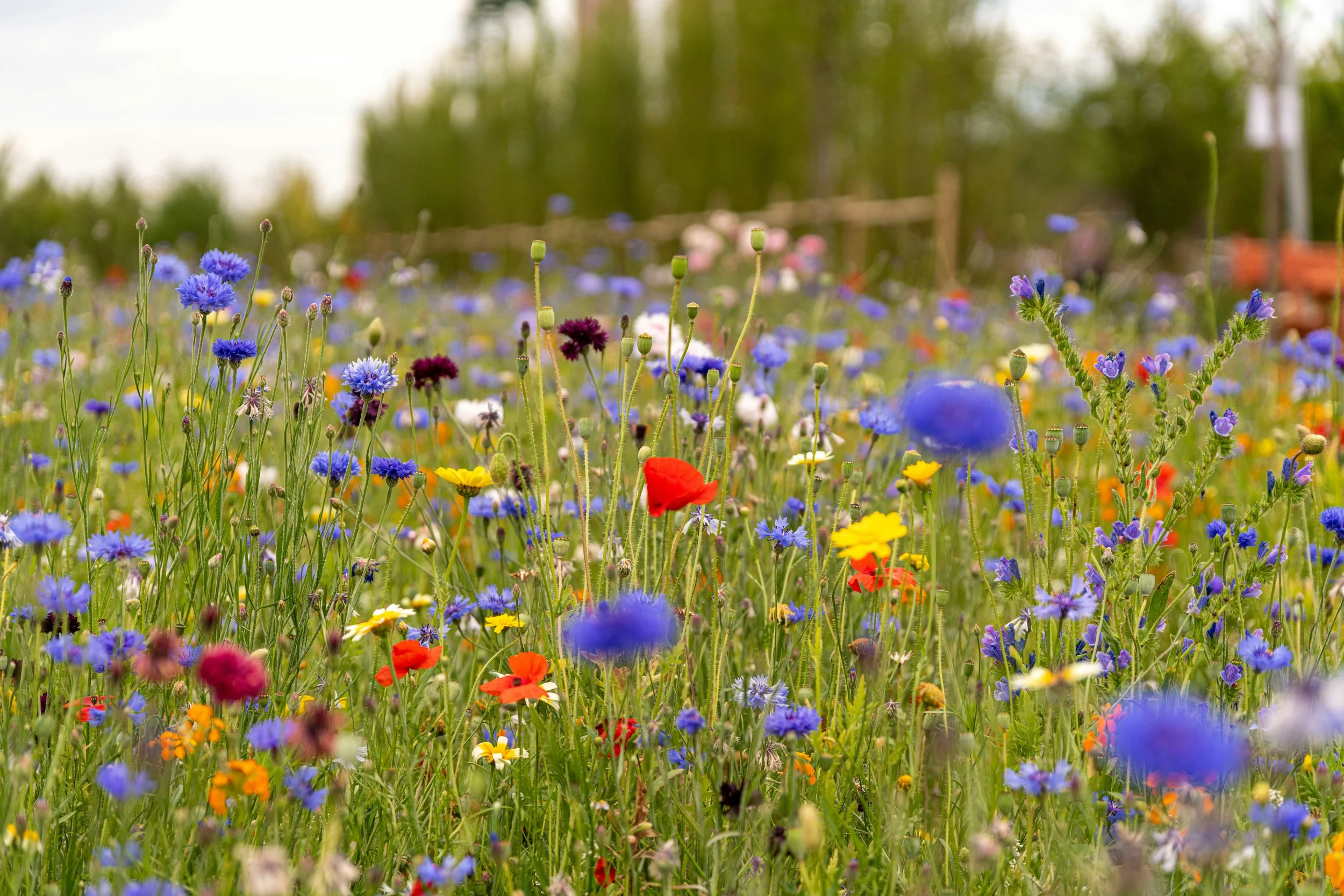
Every spring, right about the time the redbuds are showing off and the grass starts growing like it’s got something to prove, I start hearing the same dream from gardeners all across Western North Carolina: “I want a little meadow.” For many, this dream is the first step toward growing a meadow garden in their own backyard.
Not a whole farm field. Not a restoration project that requires a grant and a clipboard. Just a patch—something that feels softer than turf, more alive than mulch, more humming and generous than a typical ornamental bed. A place where the wind can move through stems and seedheads. A place where pollinators look like they’ve got a reason to be there. A place that reads like the edges of our roads and pastures used to read, before everything got either mowed flat or paved over.
And I love that dream. I really do. A meadow garden can be one of the most satisfying parts of a landscape because it gives you that rare feeling of partnering with nature instead of constantly correcting it.
But I also want to tell you the truth early, while your hope is still fresh and your seed hasn’t arrived in the mail yet: a meadow garden is not something you “sprinkle into existence.” Meadows are made, not wished into being. And the first year is almost never the postcard.
If you know that going in—if you treat the first year like a setup year instead of a failure year—you can build something that becomes easier and more beautiful with time. Something that, by year two and three, starts to carry itself.
Let’s talk about growing a meadow garden in Western North Carolina in a way that actually works: what a meadow garden really is, why site prep matters more than the seed mix, how timing interacts with our weather patterns, and what you should expect in year one so you don’t tear it all out in frustration right before it turns the corner.
Growing a Meadow Garden in Western North Carolina: Step-by-Step Tips
What do you mean by “meadow,” anyway?
In our region, “meadow” can mean a few different things, and it helps to name your goal honestly.
Some people mean a pollinator bed: a managed planting of perennials that blooms for much of the season, usually with mulch and defined edges. That’s not a meadow, but it can give you the same joy with fewer variables.
Some people mean a prairie-style planting: grasses plus wildflowers, designed to be dense and self-supporting, usually mowed or burned on a schedule. That can work here, but it requires a mindset shift away from “neat garden bed” and toward “managed plant community.”
Some people mean a naturalized patch: a small area that’s less mowed, with plants allowed to seed, with a wilder feel. That can also work, but it depends heavily on what’s already in the soil seed bank and what invasives are waiting to take advantage. This approach is often preferred by those growing a meadow garden for ecological and aesthetic impact.
When I say “meadow garden,” I mean a small area you intentionally convert from turf or weeds into a community dominated by desirable grasses and wildflowers—dense enough to outcompete many weeds once established, but small enough to manage with hand tools and thoughtful mowing.
This is important because meadows aren’t low-maintenance. They’re different-maintenance. And they require a bit of strategy at the beginning so that the maintenance becomes lighter later.
The biggest reason meadow gardens fail: competition
Here is the simplest, most brutal truth of meadow-making: grass is a champion.
If you sow wildflower seed into existing turf, you are essentially asking seedlings to compete with a mature root system that already owns the water, light, and nutrients. Understanding this challenge is key when learning how to grow a wildflower meadow that thrives rather than struggles. Turf grass is not polite. It will smile at your seed and then quietly starve it.
Even a weedy patch has an existing community that doesn’t want to give up territory. If the soil surface is shaded by living plants, your seed has to fight for contact with soil, for moisture at the surface, and for sunlight. Most wildflower seedlings lose that fight.
So the question isn’t “What seed mix should I buy?” The real question is: “How do I create a window of low competition long enough for my meadow plants to establish?”
That’s why site prep matters more than almost anything else.
Site prep: the unglamorous work that makes the magic possible
If you remember only one thing from this letter, let it be this: you need a stretch of time where the ground is mostly bare and your desired plants have the advantage—a key principle when growing a meadow garden from scratch.
There are several ways to achieve that in Western North Carolina, and which one you choose depends on your site, your tolerance for effort, and your timeline.
If your meadow garden is currently turf, one of the most reliable low-chemical methods is smothering. You can cover the area with cardboard, overlap it well, wet it down, and top it with a layer of compost or leaf mulch. The goal is to block light and starve the grass. This takes time. It’s not instant. But it’s effective, and it builds soil structure if you do it with organic layers.
The catch is that smothering is great for converting to a planted bed, but it’s not always ideal if your plan is direct seeding soon after, because you need soil contact for seed. Cardboard breaks down, but not overnight. If you’re smothering for a meadow garden, you’re often looking at a longer runway—set it up, let it cook down, then seed in the next season when the surface is workable.
Another method is repeated mowing and scalping. In spring and summer, if you mow a patch very low and very often, you can weaken certain grasses and prevent seed set in many weeds. This is less effective on aggressive perennials with strong root reserves, but it can be part of a strategy, especially if combined with solarization or selective removal.
Solarization—covering the area with clear plastic during the hottest part of summer—can be surprisingly effective in our region if you get a good seal and enough heat. The sun cooks the surface layer, killing many weed seeds and weakening existing vegetation. The downside is that it looks like a construction project while it’s happening, and it can also reduce beneficial soil life near the surface temporarily. But it’s a tool, and for growing a meadow garden, it can be a very practical one—even on a small scale.
There are also people who use shallow cultivation: removing vegetation, lightly disturbing the surface, and then seeding. This can work, but it can also wake up the weed seed bank. In Western North Carolina soils, where disturbance often invites opportunists, you have to be ready for follow-up management if you cultivate.
No matter which method you use, you’re aiming for the same outcome: a surface where your seed can touch soil, absorb moisture, and receive light without being smothered by an established plant community.
It’s not glamorous work. It’s the kind of work that feels like “pre-gardening.” But it’s what separates a meadow garden from a weed patch wearing good intentions.
Timing: the secret handshake with our weather
Western North Carolina is a place of patterns and surprises. We have wet spells that can make seed establishment easy, and we have dry stretches that can wipe out a whole cohort of seedlings in a week. We have warm spells that arrive early, and we have late cold snaps that remind you not to get cocky.
Because of that, growing a meadow garden is partly about calendar timing and partly about weather timing.
There are two common seeding windows that can work well here: fall dormant seeding and spring seeding.
Fall seeding with wildflower meadow seeds, often done after a hard frost when soil is still workable but most weed pressure is slowing down, takes advantage of winter stratification for many native species. A lot of native wildflowers want cold exposure to germinate reliably. Dormant seeding can also help your seed settle into the soil surface over winter, so that when spring rains come, you get a more natural germination pattern.
If you’re wondering how to grow a wildflower meadow, spring seeding can work, especially for species that don’t require stratification, but it’s more vulnerable to sudden heat and dry spells. If you seed in spring, you want to line it up with a period when soil moisture is likely to be steady. And you want to have a plan for watering if the weather turns cruel.
In practice, a lot of gardeners in our region succeed with a hybrid approach: they prep the site through summer, seed in late fall, and then manage aggressively the following growing season. It’s not the only way, but it often aligns well with our rainfall patterns and the biology of many native species.
Seed: less is more, and good contact is everything
One of the most common mistakes when growing a meadow garden is using too much seed. It feels counterintuitive—surely more seed equals more meadow—but in a mixed planting, too much seed can create a crowded, weak stand where plants compete with each other instead of establishing strong roots.
Seed mixes are also tricky because they vary wildly in quality and in appropriateness for our region. A “wildflower mix” that’s built for the Midwest might contain species that behave unpredictably here, or it might lean heavily on short-lived annuals that look great in year one and vanish later, leaving you with a gap that weeds happily fill.
A meadow garden in Western North Carolina benefits from a mix that includes both grasses and forbs. Grasses are not just filler. They are the structure that helps the system function. They occupy space, create root mass, and provide the matrix that can hold the planting together. Without that matrix, wildflowers can look scattered and vulnerable.
When you seed, the key is not burying wildflower meadow seeds too deep. Most of these seeds want light. You want it pressed into the soil surface, not buried like vegetable seed. A light raking, followed by firming the surface—walking over it, rolling it, pressing it—can make a huge difference. Seed-to-soil contact is the whole game.
And then you mulch lightly, if at all, depending on the seed. Too much mulch can block germination. Too little can leave seed exposed to birds and to drying winds. If you use mulch, think of a whisper of clean straw or leaf litter, not a blanket.
First-year expectations: the year of green and doubt
Now we come to the part that saves people from heartbreak.
The first year of growing a meadow garden is often not showy. It’s often green. It often looks like weeds, even when it’s not. And it often makes you question your life choices sometime around midsummer.
That’s because most perennial meadow plants are playing a longer game than our eyes want them to. In year one, many of them prioritize roots. They’re building the underground architecture that will allow them to bloom and persist later. Above ground, they may look small and unremarkable. Meanwhile, the weeds—especially annual weeds—are fast. They will take advantage of bare soil and sunlight immediately. They will look lush and dominant. They will try to convince you that you failed.
You didn’t fail. You’re just watching ecology move at its own pace.
The goal of year one is not a perfect display. The goal of year one is to prevent weeds from seeding and to protect your seedlings long enough for them to establish.
And that usually means mowing.
Yes, mowing your meadow garden sounds like the opposite of what you want. But in the first year, mowing high can be the difference between success and failure. When weeds shoot up above your small seedlings, they shade them and steal resources. If you mow the patch to a height that knocks back the weeds but doesn’t scalp your seedlings, you reduce that shading and keep the system from being dominated early.
In practice, that might look like mowing to a few inches whenever growth gets tall enough to shade the young plants. It feels like constant interruption. It feels like you’re ruining something. But what you’re actually doing is keeping the playing field level.
And the key point is to mow before weeds go to seed. If you let the first-year weeds seed heavily, you set yourself up for years of management. If you interrupt them early and often, you starve the seed bank and give your meadow species a chance to take over in year two. This careful management is a key part of growing a meadow garden successfully.
Year two and beyond: when the patch starts to hum
If you do the prep well and manage year one with discipline, year two starts to feel like a reward.
Perennials begin to show themselves. Grasses become more present. Bloom windows widen. You start seeing the patch as a community rather than as a collection of individual plants. That’s when the “meadow feeling” arrives—the sense that the patch has its own rhythm, its own movement, its own sound.
In year two and three, management shifts from “emergency weed suppression” to “maintenance with intention.” You might do a yearly mow at the right time. You might hand-remove certain problem species. For established areas, you might overseed to increase diversity, continuing your wildflower meadow planting in areas that need reinforcement.
And you’ll learn your patch. You’ll learn which areas stay moist, which areas dry out, where certain species thrive. The meadow becomes a teacher.
A practical note about edges (because aesthetics matter)
A meadow garden can look wild and still look cared for. The secret is the edge.
If you’re doing this in a residential landscape, a clean boundary makes all the difference. A mown strip around the patch. A defined curve. A path. A stone border. Something that says, “This is intentional.”
People accept wildness more readily when it’s framed. It’s the same principle as a well-edited paragraph: you can be poetic inside the lines as long as the structure holds.
A final thought: meadow-making is a kind of faith
Growing a meadow garden is one of the most hopeful acts a gardener can take, because it requires patience. You do prep work now for flowers you might not see until next season. You manage weeds now for a system that will later manage itself. You accept a year of uncertainty for a future of abundance.
And in a world that pushes us toward immediate results, that’s not nothing.
If you want help designing a meadow garden that fits your specific site—sun exposure, slope, soil type, and the realities of weed pressure in your corner of Western North Carolina—schedule a consultation through the Unicorn Farm Nursery & Landscaping website. I can help you choose an appropriate seed mix or plug strategy, build a prep and management timeline that’s realistic, and set expectations so you end up with a meadow garden that becomes more beautiful and lower-stress every year instead of turning into a recurring battle.
Warmly,
The Unicorn Farm Team