Holiday Wreaths and Greenery: From Garden to Front Door

Dear Friend,
December in the mountains carries a kind of stillness you don’t find any other time of year. The leaves have long since fallen, the garden is quiet beneath its mulch, and the air is sharp enough to make your breath visible. Yet, in the midst of this stillness, there’s work to be done — work that feels more like craft than labor. The kind of work that smells of pine sap and cold air, where the only sound might be the snip of your pruners and the soft rustle of branches.
Making holiday wreaths and greenery from what the land gives us isn’t just about decoration — it’s a form of connection. It’s walking the boundaries of your property and seeing the subtle details you might have missed in busier months. It’s knowing which cedar boughs are heavy with blue-gray berries, which hollies are glowing red against the bare woods, which vines have dried to the perfect twist for a base.
The gathering is where it begins. Out here in Asheville, we can harvest greenery right up to the week of Christmas if we choose wisely and cut with care. Evergreen species like eastern red cedar (Juniperus virginiana), white pine (Pinus strobus), and Fraser fir (Abies fraseri) hold their needles well in winter air, releasing that unmistakable resin scent every time you handle them. American holly (Ilex opaca) brings its glossy leaves and berries, though the birds will often compete for those. Mountain laurel (Kalmia latifolia), with its leathery leaves, makes a sturdy filler that lasts far longer than most expect.
The timing of the cut matters more than many folks realize. Evergreens retain moisture in their needles, but as soon as they’re cut, that moisture begins to evaporate. Cool, overcast mornings after a night of frost are ideal — the plant is holding as much water as it will all day. Cutting midafternoon on a sunny, windy day all but guarantees faster drying and early needle drop. I like to keep a bucket of water nearby, dropping the cut stems in as I go, the way a florist handles fresh flowers. Even for wreath greens, that extra hydration can stretch their life by days.
Back at the workbench — or the kitchen table, or an old barn door propped on sawhorses — the assembly becomes a rhythm. A wreath isn’t so much built as it is coaxed into being. I start with a sturdy frame: sometimes store-bought metal rings if I’m making many, but often grapevine bases gathered earlier in the fall. There’s a satisfaction in bending your own vine bases — bittersweet and wild grape, twisted while still pliable, holding a shape that will last for years.
From there, it’s a matter of layering. In this part of the country, I tend to use cedar for the background — its fine texture and subtle fragrance make it an excellent canvas. White pine adds movement with its long needles, and spruce or fir give density and a more formal look. Holly sprigs are placed where their color will draw the eye, and here and there I might tuck in dried seed heads, pine cones, or rose hips for contrast.
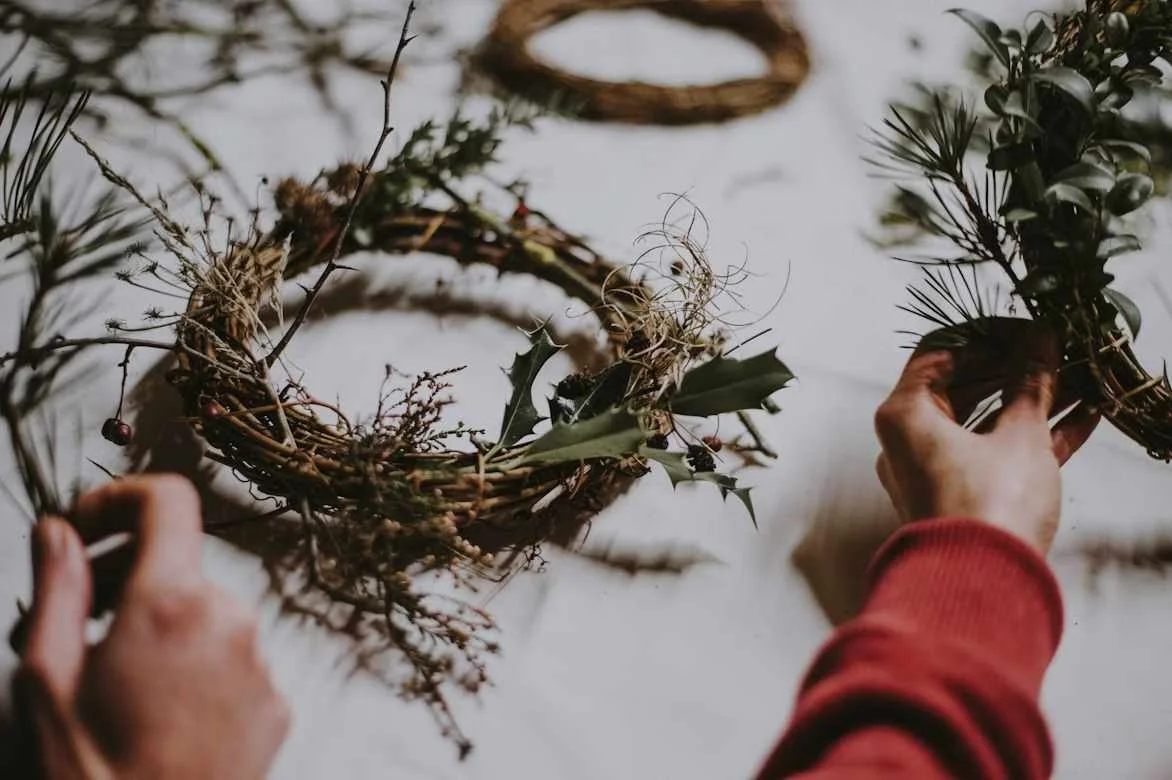
What I’ve learned over the years is that wreath-making rewards variety in texture more than in color. You don’t need every hue of green to make something beautiful; a simple interplay of fine and coarse foliage, glossy and matte, can be just as striking. Think of it like arranging voices in a song — some high, some low, all in harmony.
Once the wreath is built, keeping it fresh is a matter of location and moisture. Outdoors, a wreath can last for weeks in our climate, especially if shaded from direct afternoon sun and strong wind. Indoors, the lifespan shortens dramatically — heat and low humidity are a wreath’s enemies. I’ll often suggest misting the greenery lightly if it’s inside, or even soaking the whole wreath in a tub of cool water overnight before hanging it, allowing the stems to drink deeply once more.
There’s a tradition in these hills of making the first wreath for your own door and the next for a neighbor. I think it comes from a time when not everyone had the means or the greenery on their own land, and sharing was part of the season. Even now, I find that the best wreaths carry a bit of that generosity with them.
The work itself is grounding in a way that’s hard to explain until you’ve done it — your hands sticky with sap, your sleeves brushed with the scent of pine, the table strewn with clippings that will become mulch or kindling. It’s a reminder that the garden still has something to give, even when the beds are sleeping and the trees are bare.
By the time you hang that wreath — on a weathered farmhouse door, a city porch, or even over the mantel — it’s more than just a decoration. It’s a circle made from the land around you, holding the shape of the season, and a little of your own care in every branch and twist of vine.
Yours in the greenery,
Unicorn Farm Nursery & Landscaping